Published on Tuesday, 24 February 2026 at 10:38:12 AM
The redevelopment of Elizabeth Baillie Park and House is bringing a lot of obvious – and some not-so-obvious – benefits to our community.
Among the less apparent changes is one that encourages visitors to look up.
In February 2025, the Town commissioned the help of respected WA Ecologist and Ornithologist Simon Cherriman to enact a brand-new Urban Forest initiative at the park.
A large green area home to mature stands of slow-growing hardwood jarrah trees, as well as many other species providing food, shade and shelter to local fauna, the park was identified as a perfect candidate for The Town’s inaugural hollow creation project.
“There’s already some beautiful, established trees here that provide shade and foraging habitat,” Simon said. “The bigger the reserve, the better it’s going to be for the wildlife that will use the hollows that we’re creating.”
Taking decades – and even centuries – to form naturally through weathering, white ant activity and the like, tree hollows are in short supply in urban environments, especially as they are often present in dead trees, which become prime candidates for human removal from the environment.
Taking this into account, and the fact many endemic animal species depend on tree hollows for shelter and breeding – all in competition with a variety of introduced species seeking the same habitat – the Town sought out Simon’s help to turn two jarrahs, which had naturally reached the ends of their lives prior to development works at the park, into enduring ecological contributors.
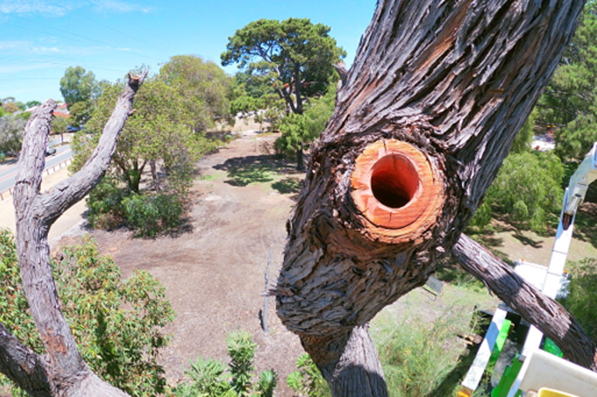
Created using a specially designed hollow-boring drill, the hollows were drilled at heights of between 3m and 10m and extend the useful lives of the trees; the hardwood status of which makes them perfect candidates for long-term habitat that is resistant to the elements.
Hollow-dependent fauna common in the metro area include:
- Parrots
- Kingfishers
- Tree Martins
- Microbats
- Skinks and lizards
- Various insects
Simon said the tree hollow project was an exciting but small part of a broader approach being taken under the Town’s Urban Forest Strategy.
“It’s really valuable to have a bird’s eye view on any environmental management and conservation actions that we take because wildlife sees the greater landscape, and our little backyards – our little reserves – they’re just tiny little pieces of a bigger jigsaw puzzle,” he said.
“So if we think strategically and we plan to do conservation actions in our parks, on our streets, in our backyards, then really we’re creating a whole landscape that is much more wildlife friendly than if we just work with a piecemeal approach.”
Want to take a look for yourself?
The trees are located on the Hill View Terrace side of Elizabeth Baillie Park, accessible via new footpaths, and are signposted.
Check out the video below for more info on this Urban Forest program, and visit Elizabth Baillie project page for more on the recent redevelopment of Elizabeth Baillie Park.
More info on the Town’s Urban Forest Strategy and associated programs is available here.
Back to All News